
How casino music influences players: insights from 15 years in gaming audio design
Casino music can influence player behavior, from the pace of betting to the perception of elapsed time. A player sits down, the soundtrack shifts, and the rhythm of play changes. Researchers have spent years examining whether these changes are connected to the surrounding sound environment. The evidence, however, tells a more complicated story than the familiar assumptions about gambling psychology.
What counts as the sound environment
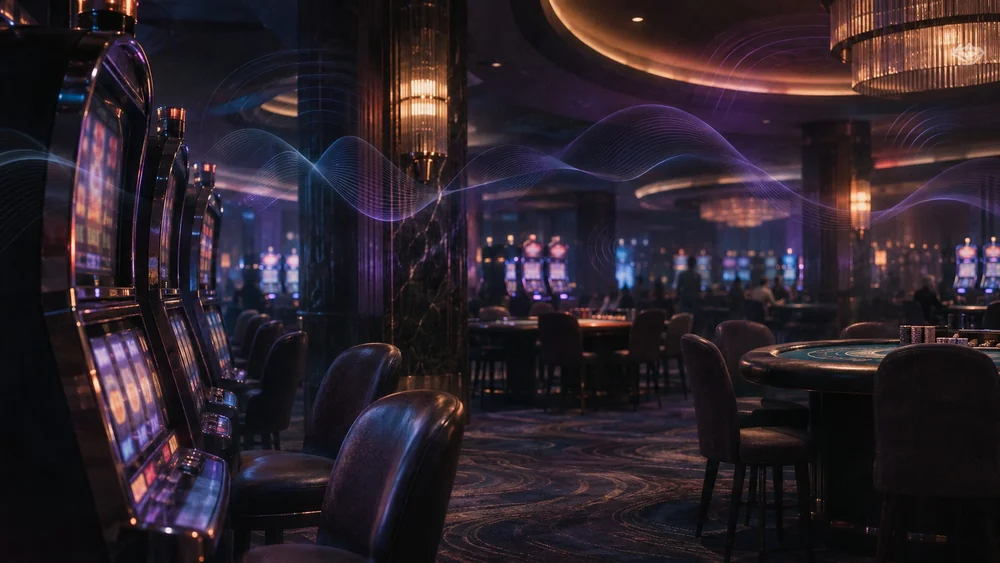
Think of the audio in a gaming space as four separate dials. Tempo is how fast the background track runs. Volume covers loudness and where it swells. Ambient sound includes the crowd, the machine hum, the room tone. Then there are result cues – the jingles and rising tones that land after a win or a near-miss. Each component can be studied separately or in combination with other sensory elements.
Indie and metal crowds already know this language. A drummer changes the energy of a room without changing the song. A producer can build tension through dynamics alone. That attention to musical detail feels at home at Jabberjaw Media, an independent podcast network founded in 2015 by Matt Carter, Nick Bunda and Mike Mowery.
The network's roster has included shows such as Break It Down with Matt Carter, The Ex-Man with Doc Coyle and The MetalSucks Podcast. These shows connect listeners with people working inside the music industry. Looking at casino audio through a similar lens means paying attention to how sound works rather than buying into the mythology surrounding it.
What research says about tempo
One study on musical tempo took place in a laboratory rather than a casino. Mentzoni and colleagues published it in 2014: 101 students played a computerized gambling task while background music ran slow or fast. The slow-music group placed more bets. Fast music shortened the time each player took to place a bet. Both findings came from the same controlled experiment.
The study measured betting persistence, reaction time and game evaluation, not actual session duration or net financial losses as separate outcomes. Participants received starting credits, and winnings were paid out in cash. The findings describe behavior among university students in a controlled setting, not spending patterns across U.S. casino floors. More bets do not necessarily mean greater financial losses.
| Study condition | What was measured | Limits on interpretation |
|---|---|---|
| ☀️ Slow background tempo, lab task | Higher number of bets placed | Student sample, laboratory setting, no direct measure of session duration |
| 🩷 Fast background tempo, lab task | Shorter reaction time per bet | Same lab setting; speed of action is not spending |
| 🔶 Ambient sounds with vs. without music | Time perception and task absorption | Narrow comparison; not generalizable to all players |
A 2009 study by Noseworthy and Finlay examined how music, volume and ambient casino noise affected time perception among 160 participants. Those exposed to ambient sounds alone tended to underestimate elapsed time, while the addition of music helped participants estimate it more accurately. Tempo and loudness also mattered under the experimental conditions. The findings challenge the familiar assumption that music necessarily makes players lose track of time.
When sound and visuals work together
Feeling that a session went fast and the clock reading are not the same thing. A player can swear an hour has passed while the timer says 20 minutes. Perceived time and actual session duration are different measures, and the available findings do not establish that music consistently extends gambling sessions.
A preregistered sensory feedback experiment offers more recent evidence. The study was published online in March 2026 in Psychology of Addictive Behaviors with the print issue dated June 2026, led by Mariya V. Cherkasova of West Virginia University. Participants played 200 spins in a simulator. Stronger audiovisual feedback shortened the wait before the next spin. Bet size held steady. So did the players’ own accounts of the experience.
The catch: feedback bundled visuals with sound, so the result cannot be isolated as a music effect, and the sample was not established as representative of U.S. gamblers. Whether the same pattern appears on a live floor in the United States remains an open question.
Where each sound component stands
The findings above attach to specific dials, not to the soundscape as a whole. Setting them side by side makes the pattern easier to see: what got measured, and what stays unknown until someone runs a dedicated test on that one component.
| Component | What could be measured | What cannot be concluded without a dedicated test |
|---|---|---|
| 🔵 Background tempo | Number of bets placed, reaction time | Real-money losses, total session duration |
| 🔴 Win-result cues (jingles, bells) | Time between spins | Whether the effect comes from sound alone |
| 🟠 Ambient crowd and room tone | Time perception, absorption | Effects on bet size or spending |
| 🟣 Volume and its shifts | Attention and arousal markers | Any universal effect across player groups |
How to read these studies without overreading them
Narrow, controlled setups produce most of this research, and each finding carries conditions attached. To determine whether a claim about casino sound is supported by evidence, follow these steps:
- Identify the study population. Establish whether the research involved students, online volunteers, or actual casino players.
- Examine the experimental conditions. Determine which sound components were tested and what conditions were compared.
- Analyze the measured outcomes. Establish what the experiment actually demonstrated, distinguishing betting frequency, reaction time, self-reported experience, and real spending.
- Assess the applicability of the findings. Use the information gathered in the previous steps to determine whether the results can reasonably be extended to real-world casino environments.
This process helps readers move from understanding the experimental setup to drawing conclusions that remain within the limits of the evidence.
A checklist for evaluating the next study you see
Headlines about gambling psychology often go further than underlying research. Several indicators can help readers judge the reliability of a scientific claim:
- Source transparency: Access to the original research rather than a media summary.
- Research funding: Disclosure of financial support and potential conflicts of interest.
- Preregistration: Evidence that the research plan was documented before data collection.
- Replication: Independent studies examining similar effects under comparable conditions.
These indicators help put scientific findings into context. A compelling headline is no substitute for transparent research, and a single experiment rarely settles a broader question about human behavior.
"Music is the shorthand of emotion. Emotions which let themselves be described in words with such difficulty, are directly conveyed to man in music, and in that is its power and significance." — Leo Tolstoy
(often cited in behavioral audio design for its precision on subconscious emotional cues)
Tolstoy wrote that in his diary about music carrying feelings – not about gambling floors – and it reads as an observation about emotion, not proof of any wagering effect. Still, it explains the pull of this research area. If music communicates below conscious description, its pace plausibly shapes behavior in ways people cannot report afterward. Cherkasova's findings offer a related observation: participants played faster without reporting a corresponding change in their experience, which is exactly the kind of shift a listener would struggle to describe.
So where does that leave the reader? Between two extremes, both overstated. Controlled studies show measurable shifts in tempo of action under specific conditions – more than nothing. They do not license the sweeping line about sound making everyone lose track of money and time. A lab task, a simulator, one comparison: each describes its own conditions, and individual experience of a gaming room in the United States or anywhere else varies around whatever the averages say. Treat every strong claim about casino audio as a question about samples, conditions, and measurements. That is how the evidence should be read.